
I Logged My 4×4 for 30 Nights. The Low Landed at 4:10am Every Time.
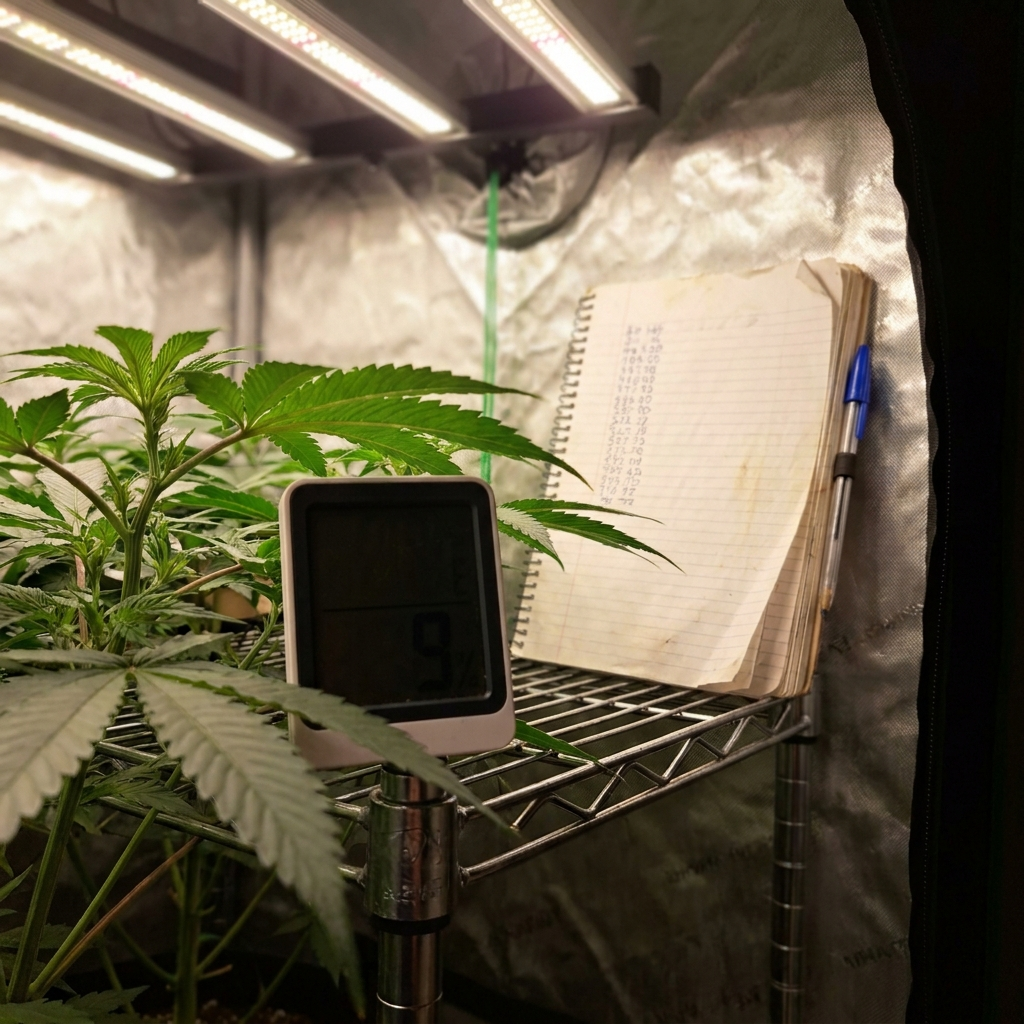
Unheated garage, lights-off set point 68°F, one logger at canopy and one at the top of the tent. Three heaters over three winters. The graph says the same thing every time: it was never a wattage problem, it was a control problem, and the two loggers ran 8 to 12 degrees apart on the nights that mattered.
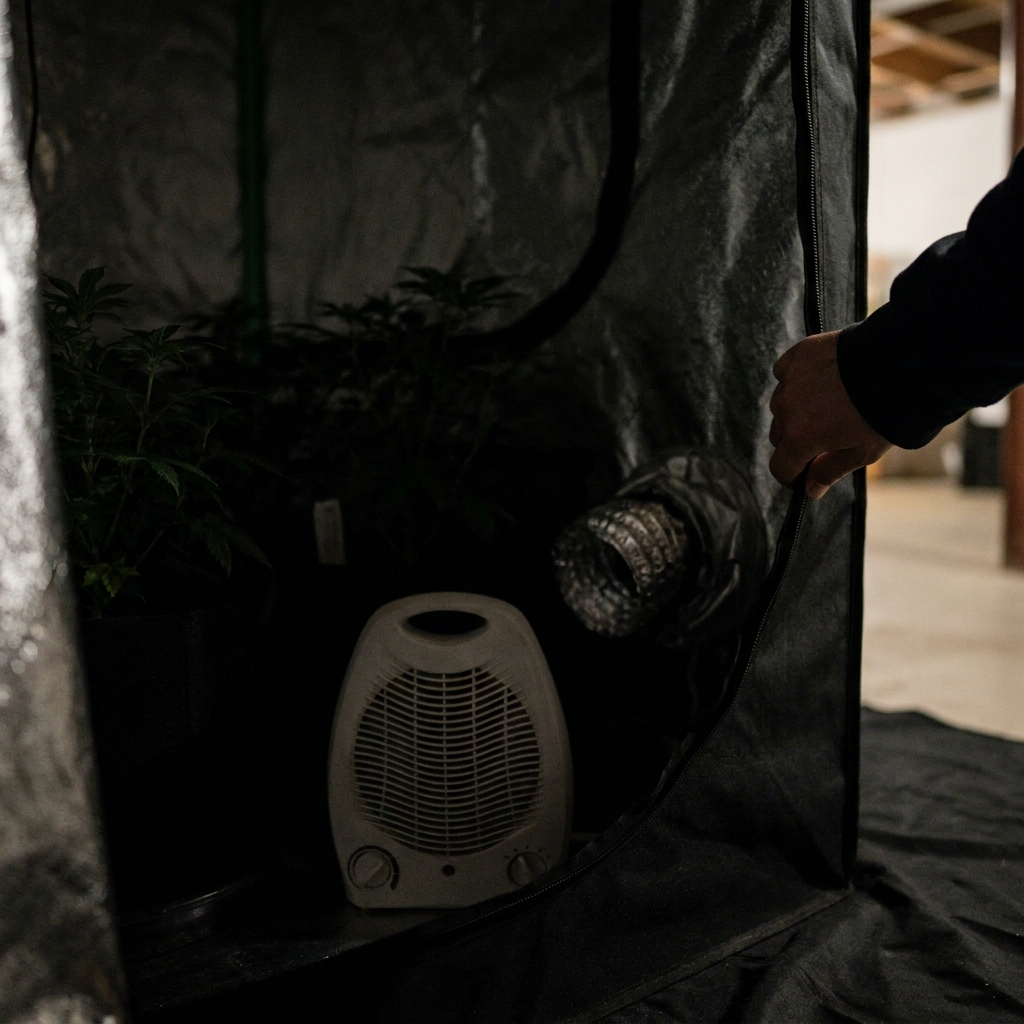
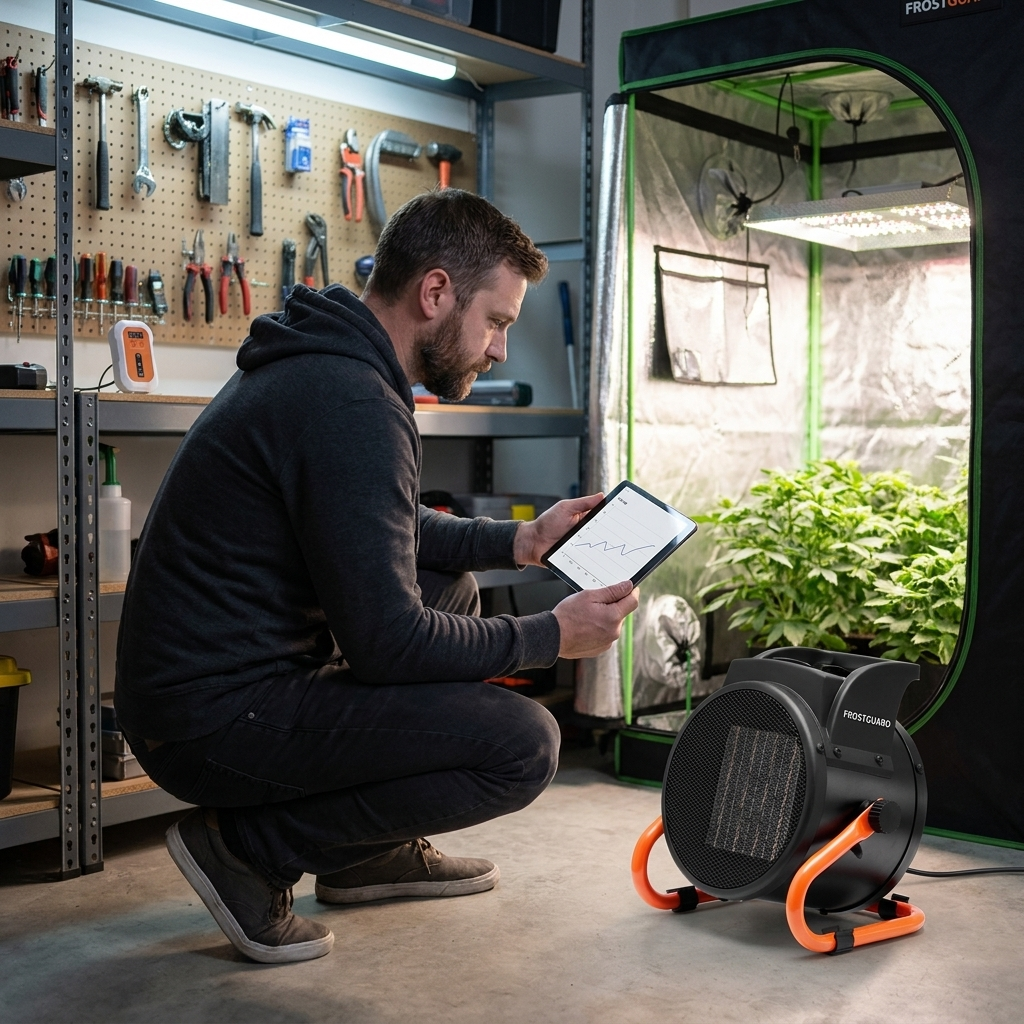
The Low Lands at 4am, Not at Lights-Off.
Everyone sets the heater up for lights-off. That's the wrong hour. Lights go off at 9pm and the tent coasts on stored heat from the fixture, the pots and the mylar for about three hours. Then it tracks the garage, the garage tracks outside, and outside bottoms out just before dawn.
Thirty nights logged at canopy height. The low landed between 2:40 and 4:50am every single time. Median 4:10.
Worst night the canopy touched 61°F for about forty minutes with a 1500W unit that had been running since lights-off. It wasn't off and it wasn't undersized. It had satisfied its own internal sensor hours earlier and was cycling on a reading taken two inches from its own element.
And nothing happened. That's the part that makes this hard to catch. No lockout, no wilt, no incident you can point at in the morning. Just a cycle that came in light with no single night to blame.
Probe at Canopy. Not Top of Tent. Not the Outlet.
A sealed 4×4 with an inline exhaust pulling from the top stratifies hard. Two loggers ran 8–12°F apart most nights — top of tent warm, canopy cold — because the exhaust is scavenging exactly the air the heater just made.
Three places people put the sensing end, and only one of them is right:
| Where it sits | What it's actually measuring |
|---|---|
| Inside the heater casing | The element. Satisfies in four minutes, cycles off while the canopy drops |
| Top of tent / near the exhaust | The warmest layer in the space, on its way out of the building |
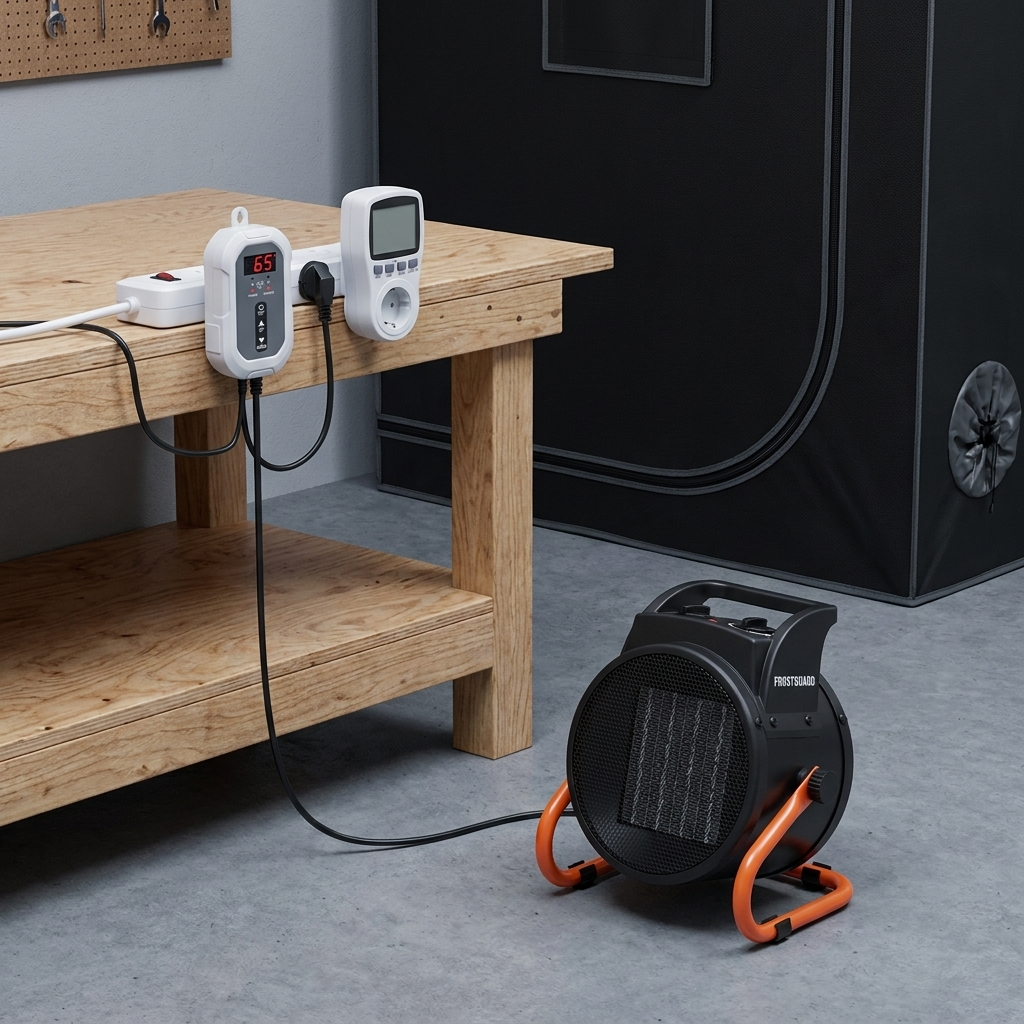
| Plug-in thermostat socket at the outlet | The room, outside the tent, at outlet height |
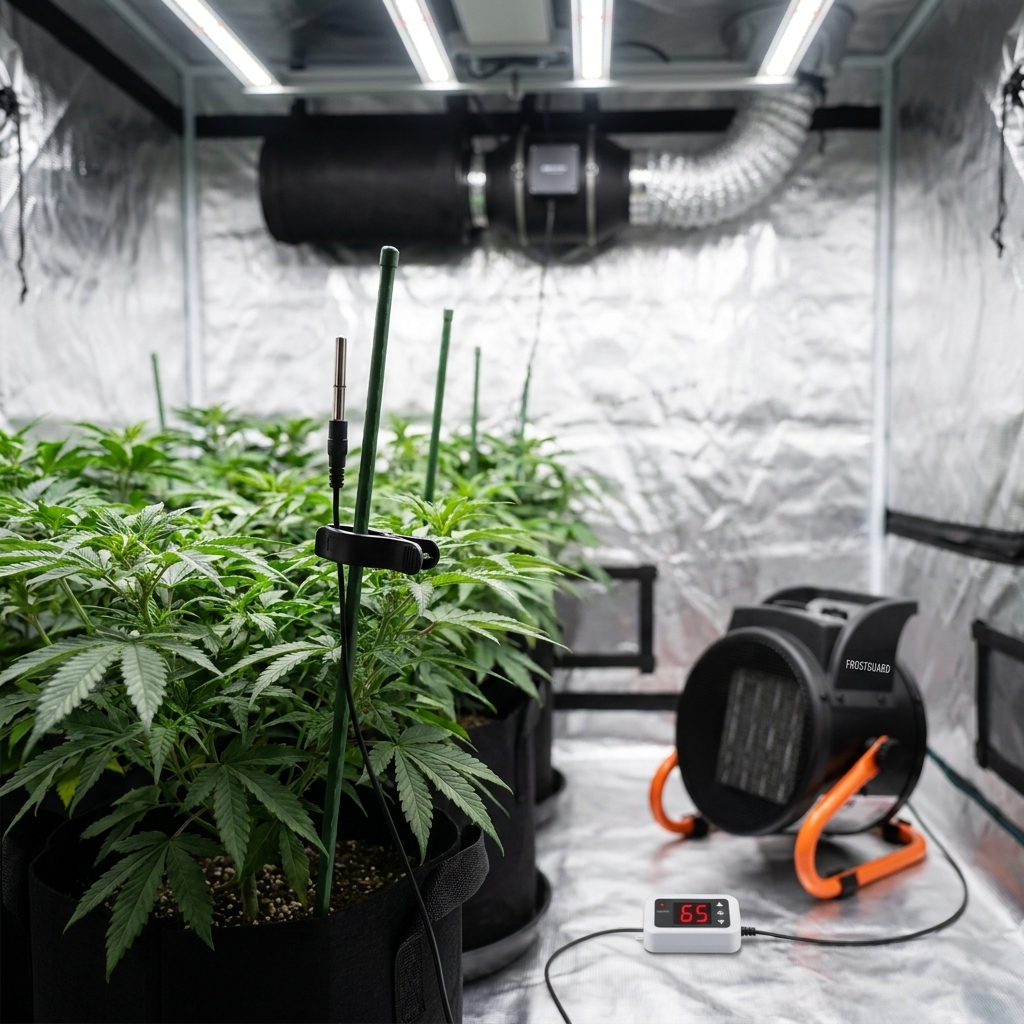
| Canopy, far side from the heater | The air your plants are in |
The plug-in socket is the one that stings, because buying it is the right instinct. You worked out on your own that a heater running on its own dial is a heater guessing. You built the right system and put the sensing end where it was convenient to put it.
What I run now is a probe on a lead, clipped to a stake at canopy on the far side, shielded from direct throw. Controller range is 40 to 108°F. If that point holds 68, the tent holds 68.
12.5 Amps Continuous Into a Relay Rated for 10.
This one cost me a tent and I want to be specific about why, because the usual advice is "buy a better smart plug" and that isn't the lesson.
A 1500W heater pulls 12.5 amps, continuous. Not a startup spike. Not a duty cycle. A steady 12.5 for however many hours the thing is calling for heat.
| What's printed | What it means | Where you find it |
|---|---|---|
| 15A / 1800W | Resistive max, tested short | On the housing |
| 10A / 1100W | Continuous rating | In a datasheet, if published at all |
Both numbers are true. Only one of them describes what you're doing to it at 4am in February.
Run 12.5 continuous through a contact designed to sit at 10 and it works. It works for weeks. Then the contacts pit, resistance at the contact climbs, it runs hotter, the pitting accelerates, and eventually the thing either stops switching or welds shut.
Welded shut is the one that cooked a tent to 97 while I was at work. The heater didn't fail — it did exactly what it was told for nine hours, because the relay had stopped being a switch and become a wire. I replaced the heater after that, which was the wrong lesson and eighty dollars.
Obvious comeback, and somebody will post it: the controller I run now is a relay too. Everything that switches mains power is. A relay sized for the load it carries is a solved problem. A relay sized for a table lamp is not — and this category is full of the second kind sold as the first.
Meter It at the Plug End, Under Load, Not at the Wall.
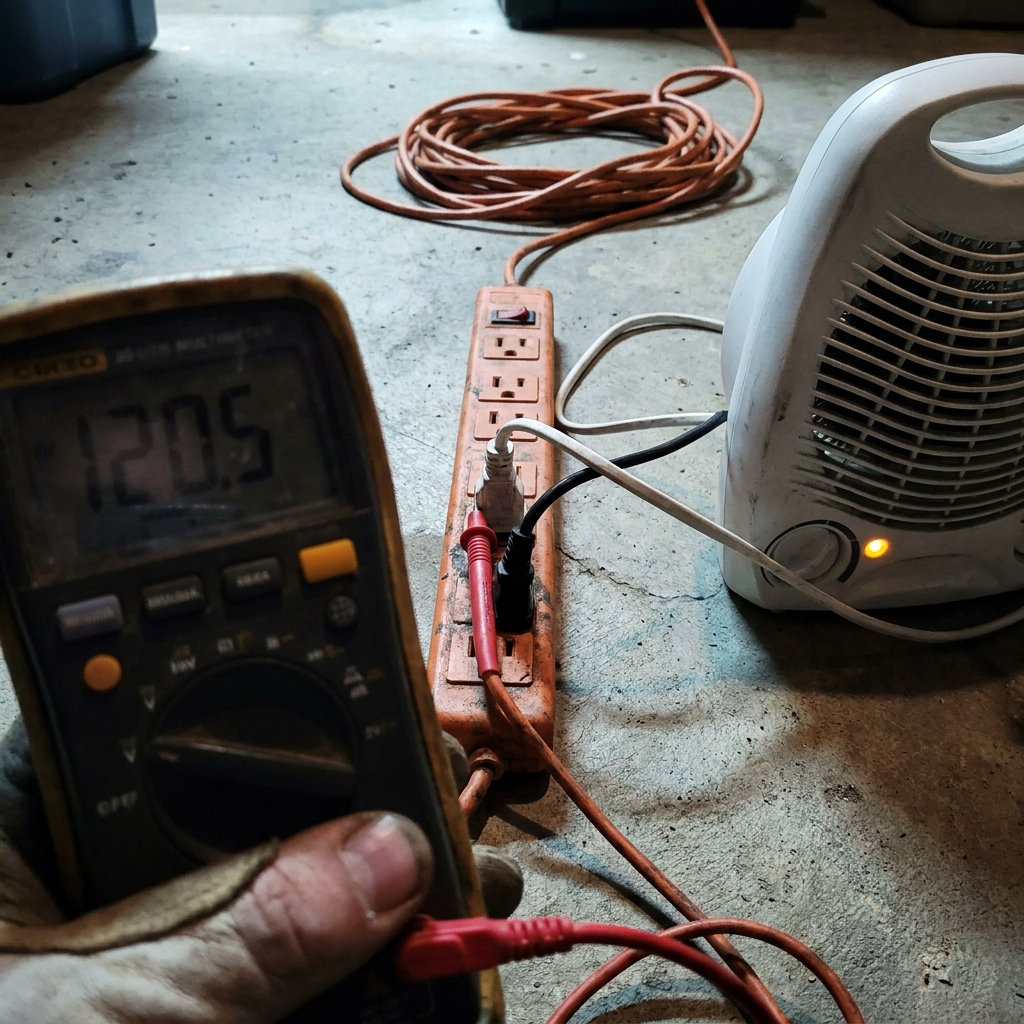
Before you buy anything else, do this. Meter at the outlet, then meter at the plug end of your cord with the heater running. Under load, not idle — the idle reading tells you nothing, because the drop is current dependent.
12.5A continuous down 50 feet of 16 gauge loses you somewhere in the region of 15 volts. So a unit specced for 120 is being handed roughly 105.
Two consequences, and the second one is the one that actually costs you.
Power output drops, roughly with the square of the voltage ratio, so a 12% voltage drop is a meaningfully bigger hit than 12%.
And the fan slows. That's the one nobody mentions. A resistive element still makes heat at reduced voltage, but a motor at 105V turns slower, moves less air, and stops distributing. The heat pools around the unit and the far corner never comes up. You get a hot spot and a cold tent at the same time, which is exactly the symptom people misread as not enough watts.
14 gauge minimum. 12 if the run is long. Shorten the run if you can — length is doing as much work as gauge.
Voltage drop explains why it underperforms. It does not explain why it stops running.
That's two different problems and I fixed one of them two seasons before I understood the other.
PTC vs Nichrome Is a Materials Fact, Not a Spec Line.
Everyone in this category prints PTC on the box and nobody explains what it means, so here it is.
A nichrome coil is a fixed resistance. Push current through it, it heats, and it keeps heating as long as you keep pushing, because nothing about the wire objects. That's why a coil glows and why a blocked intake on one is a genuine problem.
PTC is positive temperature coefficient. The resistance of the ceramic rises as its temperature rises, and not linearly — the curve goes steep. So as the element heats, its own climbing resistance throttles the current that's doing the heating. It walks up to a point and stalls out, because it can no longer draw the power it would need to go further.
That ceiling sits well below the surface temperature required for visible incandescence. Not dimmed, not shielded, not a low setting. The element refusing to take the power.
Block the intake with a bit of fabric and it still can't climb past its curve. It underperforms, the thermal cutout does its job, and the failure mode isn't a runaway.
Scoped properly, because I'd want it scoped: that's a statement about what the element can reach. It is not a claim that a mains appliance in an enclosed nylon space is incapable of causing a problem, which would be a stupid thing to say. IP20, dry locations, clear space around it, 14 gauge cord.
Duty Cycle Is the Bill. BTU Shopping Doesn't Fix a Control Problem.
A 4×4×7 is 112 cubic feet. A 1500W PTC unit is 5,100 BTU/hr. That is, by a wide margin, more than a sealed 4×4 can absorb — the 800W setting was already overshooting before I got the probe in the right place.
I didn't need a bigger heater. I needed the one I had to stop at the right moment and restart at the right place. And that turned out to be where the money was too.
| Setup | kWh / night | $ / month @ 17¢ |
|---|---|---|
| 1500W, no control (12h, 100% duty) | 18.0 | $92 |
| 1500W + socket reading the room (~45% duty) | 8.1 | $41 |
| 800W + probe at canopy (~22% duty, measured) | 2.1 | $11 |
The heater didn't get cheaper. It got shorter. Wattage is how hard it hits; duty cycle is how long, and how long is the entire bill.
A heater without a probe at the canopy is an open loop — you are the feedback, at 4am, in the garage. A probe and a set point is a closed loop: it measures, it acts, it measures again. That's the whole difference, and it's why the same 1500 watts that failed me for three winters now holds 68 to within a degree and a half while I'm asleep.
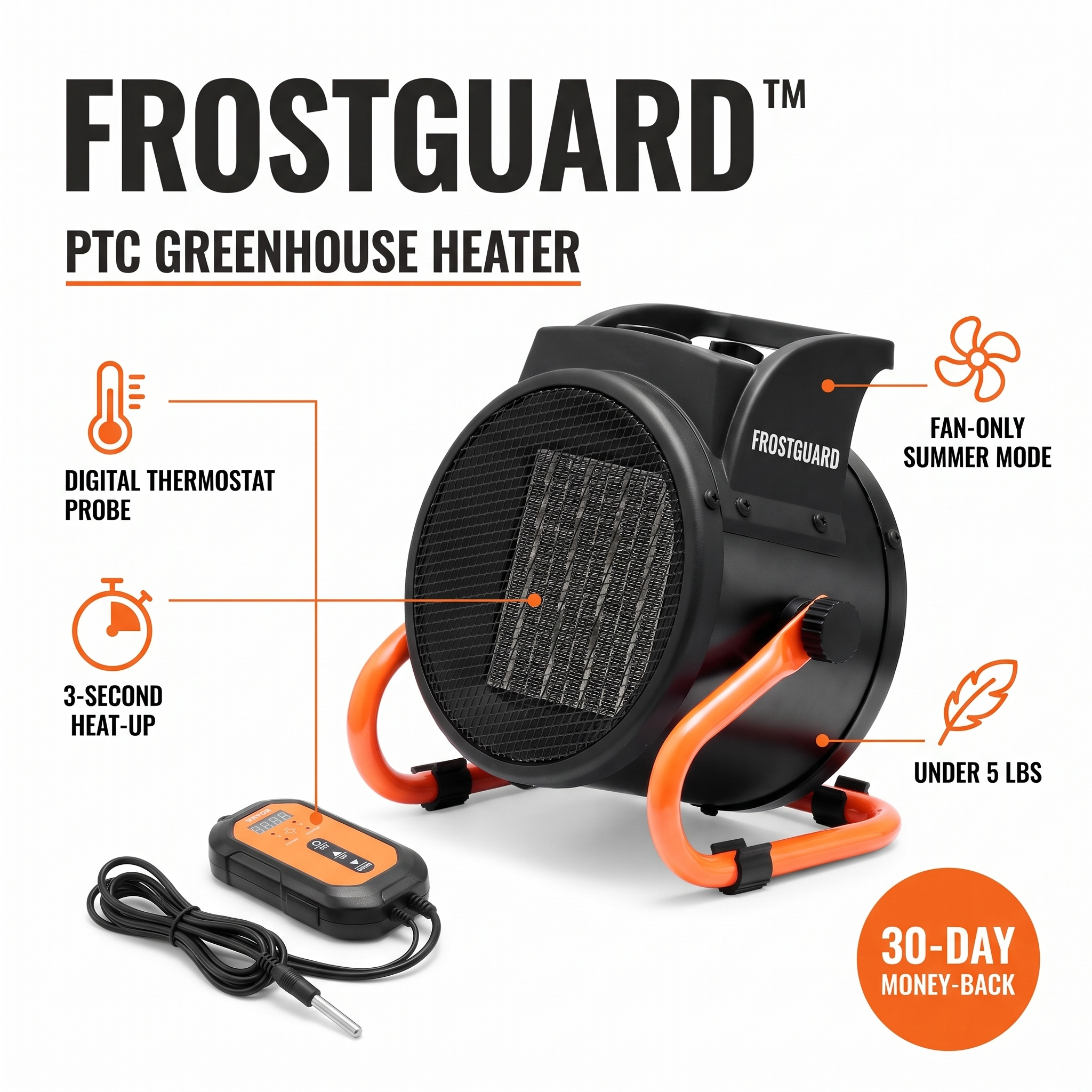
A closed loop with nothing clever in it. Probe at canopy, one set point on a discrete controller, an element that self-limits by resistance curve, fan-only for the warm end of the year. Specs below including the one that disqualifies it for some people.
Why 50% off in September? Because the people ordering a heater in September have a logger and a plan, not a dead tent. Early orders get the price. When the first cold snap hits and everyone buys at once, it goes back up.
Same loop every time. A probe where the plants are. A set point instead of High/Low. An element that can't run away. And a heater that's off more than it's on — which is the only thing that ever moved the bill.
$79.95 during the Fall Sale — half off, free shipping, 30 days to send it back. Probe at canopy, one set point, PTC element that self-limits, 40 to 108°F range with no firmware floor. Single set point, no differential band — if that's a disqualifier for you, it's a disqualifier, and I'd rather you know before you click than after.
Get FrostGuard — 50% Off →