
I Lost 86 Cells on March 19th With the Heat Mat Running. Warm Roots. Dead Tops. Both Readings Were Correct.
12×8 double poly. Mat on a controller holding 75 in the medium, heater on a thermostat socket set to 40, probe hung at chest height. Three deliberate decisions by somebody paying attention. The medium was still at 75 at six in the morning and the canopy four inches above it was at 29, and not one piece of equipment I owned was faulty.

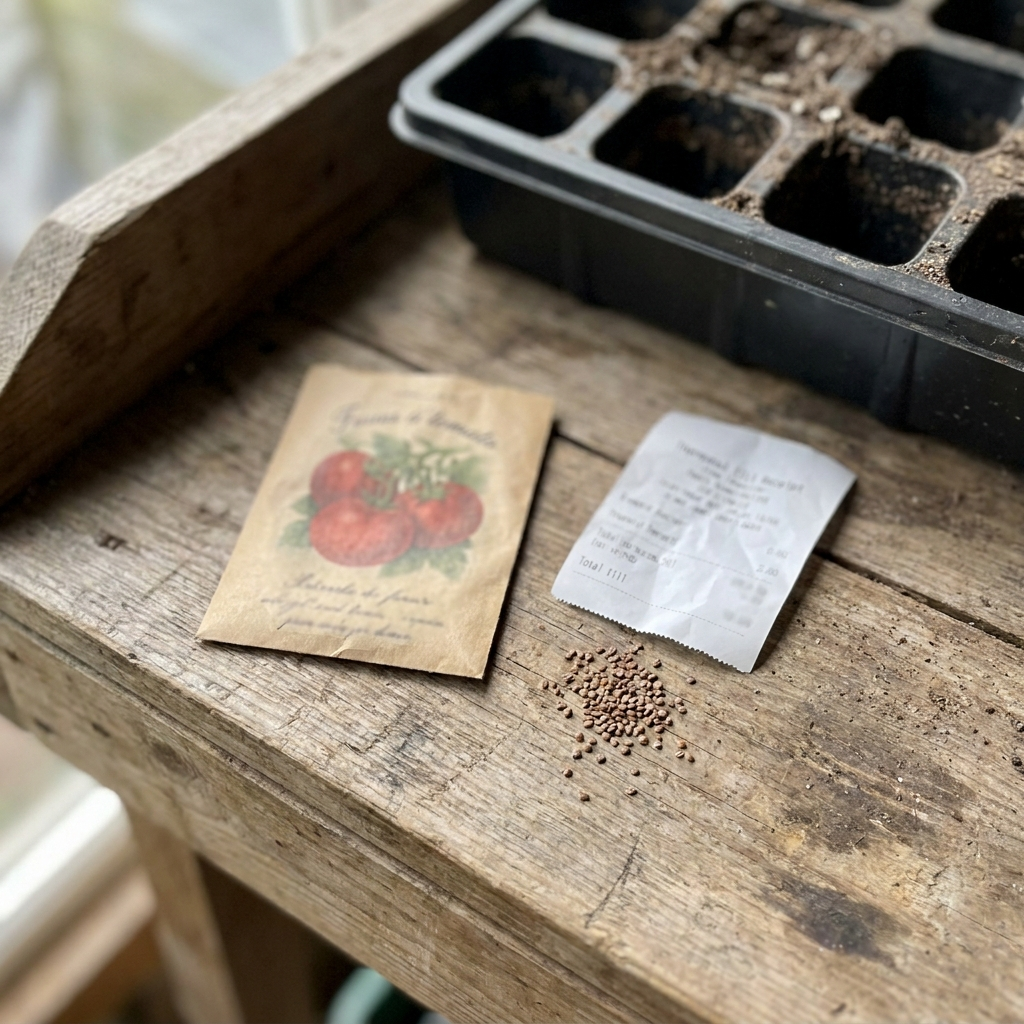
March 2nd to March 19th. Seventeen Days, and the Mat Was On.
The date isn't sentimental. March 2nd is counted backwards from last frost, minus hardening off, minus the week the transplants sulk. It's the date that gets me fruit in July instead of fruit in September. I write it on masking tape on the end of the tray, same as you do.
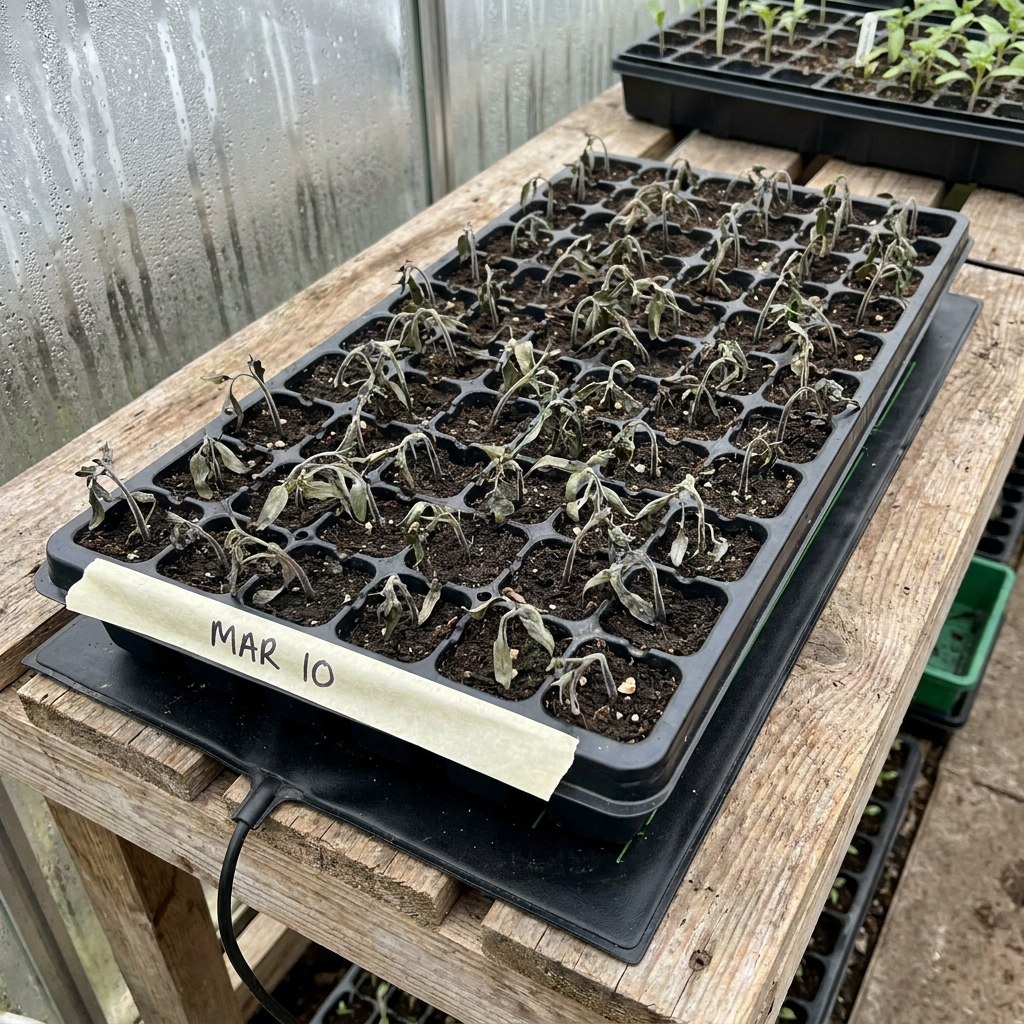
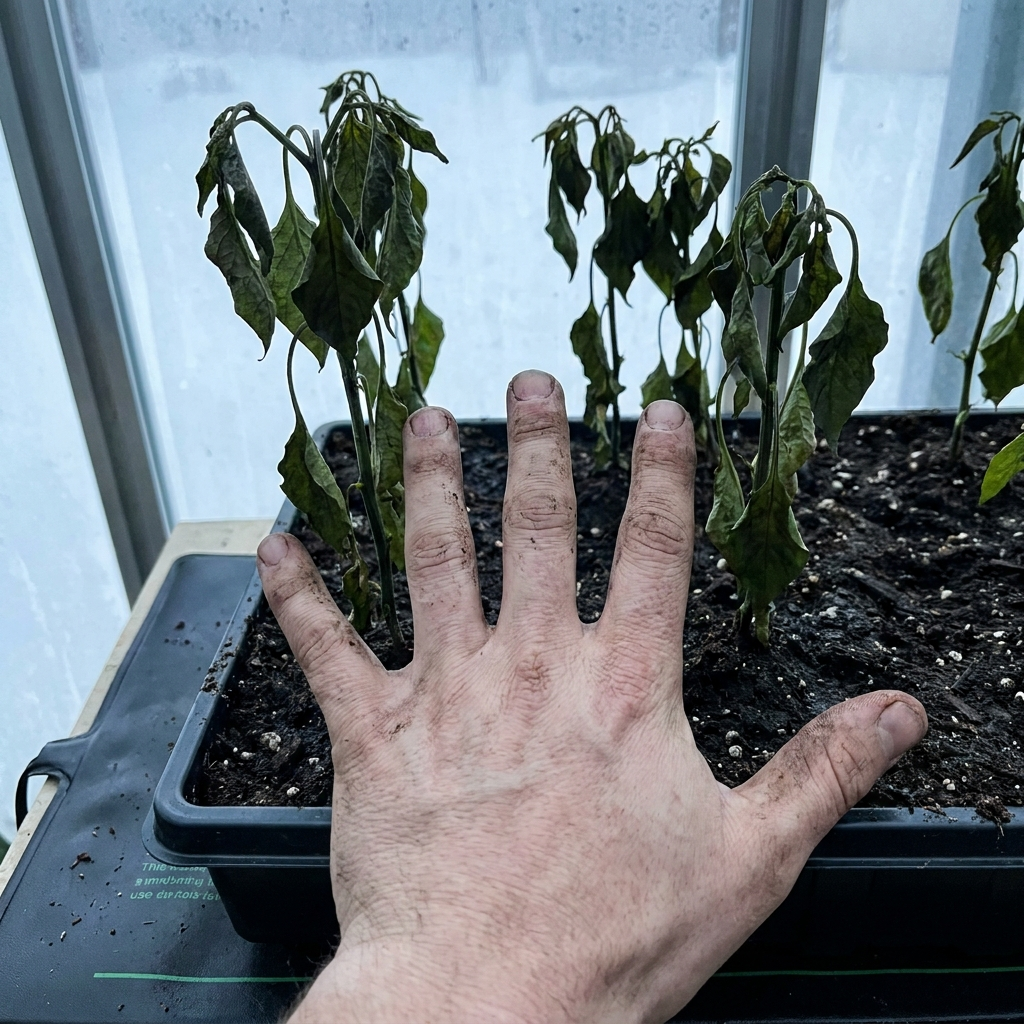
March 19th I came out at about half six and the whole flat was glass. Not wilted. Not set back. The cotyledons had gone translucent and the first true leaves were water. Eighty six cells, four varieties, two of which I can't buy as plants anywhere within an hour of me.
And the mat was on. I put my hand flat on the tray and it was warm, the way it had been every morning for seventeen days.
Here's the part that doesn't translate to anybody outside this. I didn't lose a tray of tomatoes. I restarted that week — seed is four dollars. What I couldn't restart was the date. Transplant moved from the second week of May to the third week of June, and everything downstream of that moved with it.
Six weeks off the front of a season isn't a setback. It's the season.
Warm Roots. Dead Tops. Both Readings Were Correct.
I want to defend the mat before anything else, because I've watched this conversation go wrong in groups about six times.
The mat is not the problem. If yours is holding 75 in the medium it's doing its job perfectly, there's nothing wrong with it, and you didn't buy the wrong one. Mine is under a tray tonight and it will be every February for the rest of my life.
Now the awkward bit. A heat mat has never raised the air temperature in a greenhouse. Not once, not yours, not the expensive one. That isn't a failing — it's not what it does.
The mat works by conduction. It's in physical contact with the tray, and heat climbs through the tray into the medium. Contact is an extremely efficient way to move heat, which is exactly why a mat holds 75 in a greenhouse sitting at 32.
The air above the tray isn't in contact with anything. It moves by convection, it's governed by the volume of the structure and how much of it leaks, and a mat under a flat has no mechanism by which it could warm it.
So on March 19th my medium was at 75 and my leaf canopy was at 29, four inches apart, and both of those numbers were exactly what my equipment was designed to produce.
Fourteen Degrees, Twelve Feet Apart, Same Moment.
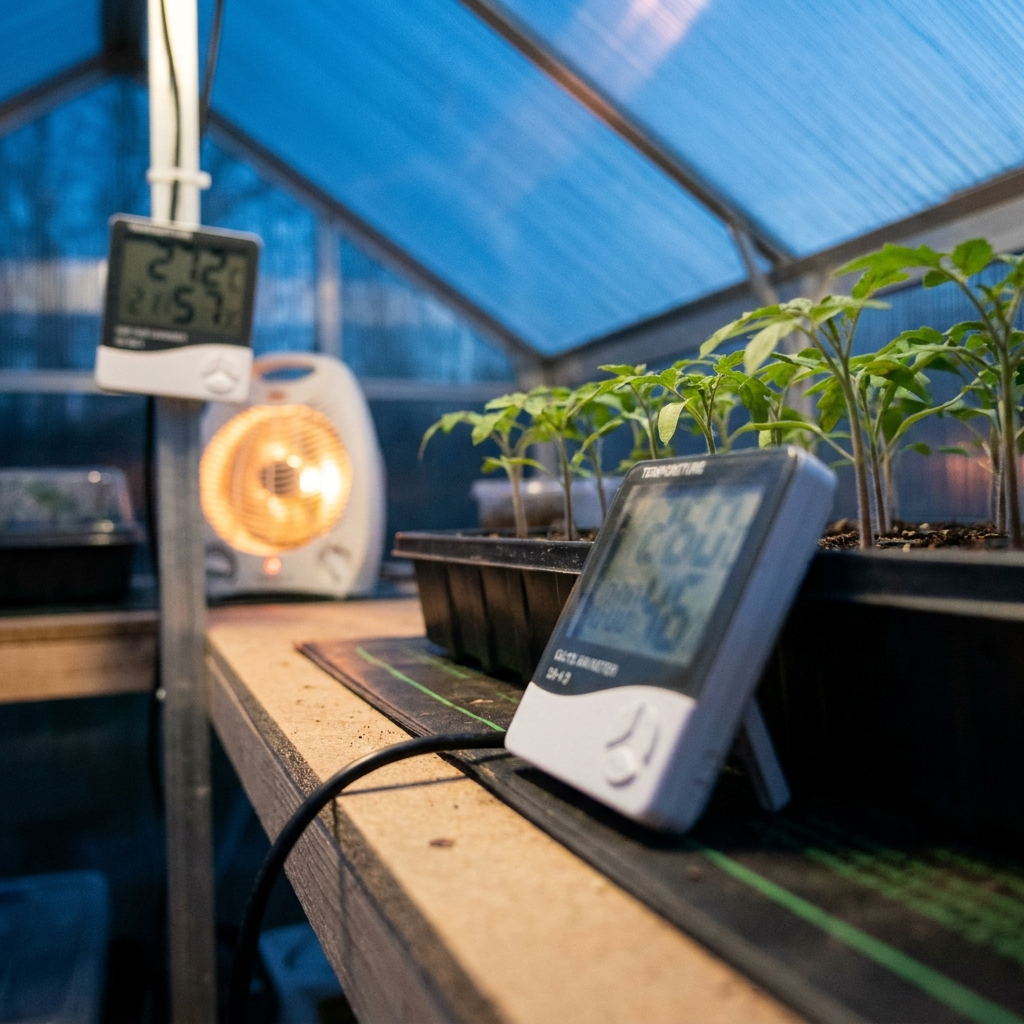
Second week of March I did the stupid obvious thing. Second thermometer on the tray itself, propped against the edge of the flat at the height of the tops. Left the first one where it had always been, chest height near the heater end. Went out at half eleven and photographed both.
| Where | Reading | What it was describing |
|---|---|---|
| Chest height, heater end | 45°F | The air my probe was hanging in |
| Seed flat, top of canopy | 31°F | The air my seedlings were in |
I checked the second one against a third in the kitchen the next morning because I assumed it was faulty. It wasn't. Accurate to within a degree.
Once you've seen that with your own two eyes a lot of things stop being mysterious and start being annoying. There is no such thing as "the temperature in there." Air stratifies. Warm air rises off the element and sits along the top, cold air pools at floor level and along the glazing, and the gradient works hardest on exactly the nights that matter most.
And the gap isn't fixed. Still night, maybe eight degrees. Windy with eighteen outside, nineteen. There's no arithmetic that survives that — and I had been doing arithmetic. Reading 45, subtracting fourteen in my head, turning the socket up to 55 to compensate.
I Built the Right System and Put the Sensor in the Wrong Place.
I already had a thermostat socket. I bought it years ago, on my own, because I'd worked out that a heater running on its own dial is a heater guessing. If you've done that too, you were ahead of most people and nobody had to tell you.
And it was doing exactly what I told it. It held its probe at 40 all night, beautifully, while the tray sat at 31 — because I'd hung the probe where it was convenient to hang it rather than where the plants were.
The problem was never that the numbers disagreed. It was that the wrong one was in charge.
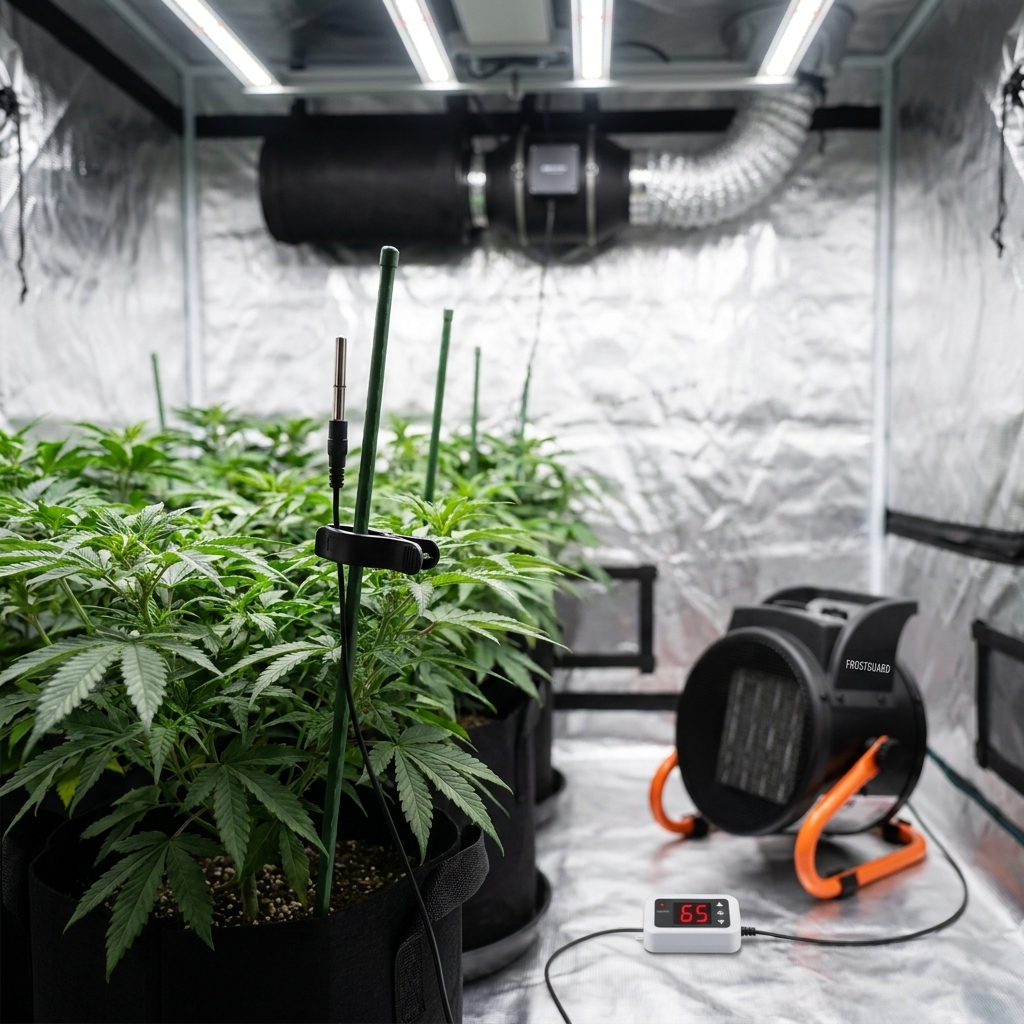
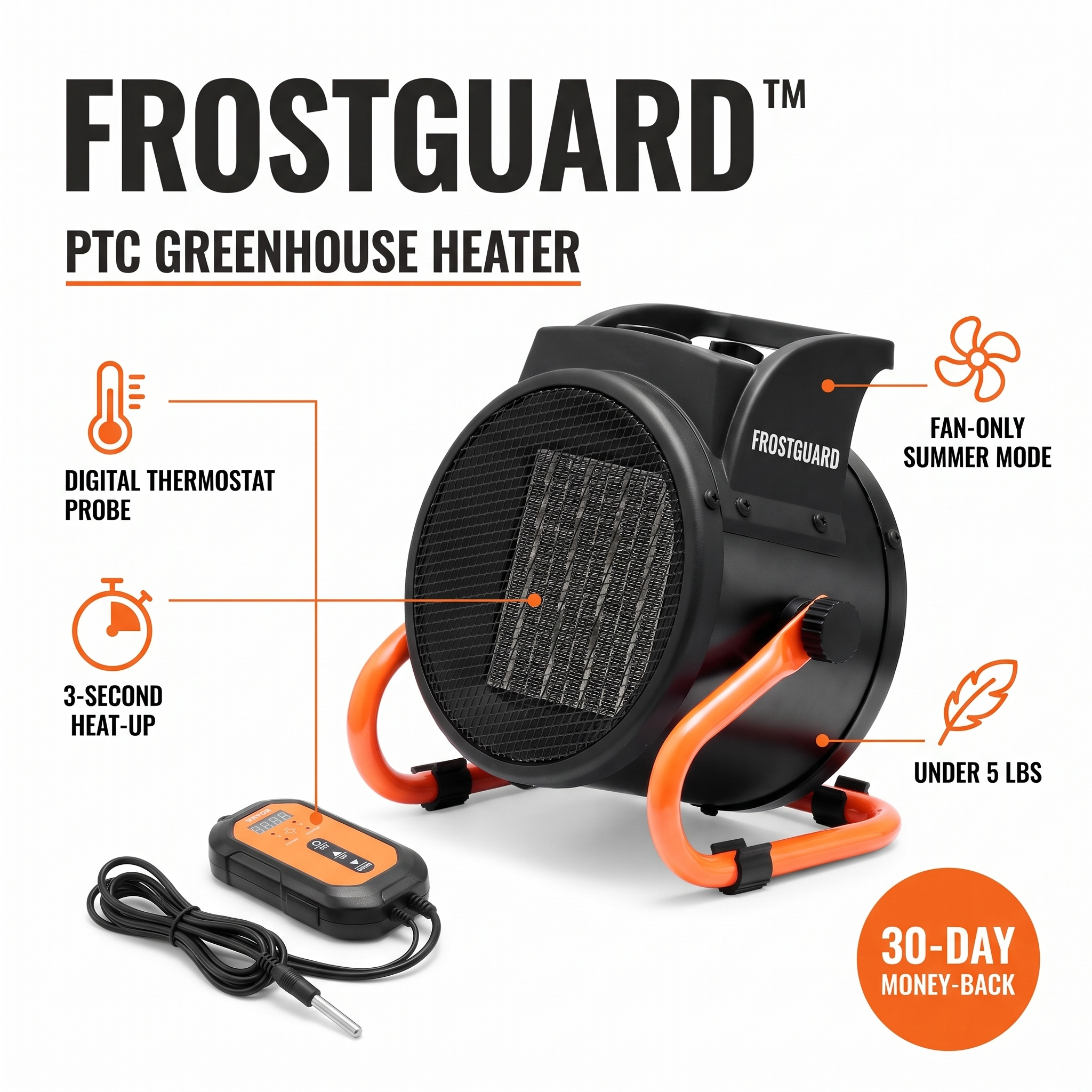
So the fix wasn't a better heater and it wasn't a better socket. The socket's in a drawer. What's out there now is a controller with the probe run down onto the bench, clipped to the side of the flat at the height of the tops. Not in the medium — that's the mat's job. In the air, where the damage happens.
Two problems. Two sensors. Two settings. The mat holds 75 in the medium, the controller holds 40 in the canopy air, and for the first time they aren't pretending to be one thing.
First properly cold night after, I went out at eleven out of habit and took the same two photographs. 41 and 40. Not because the gradient went away — it's still there and always will be. The thermometer up by the heater reads higher than it used to, because the heater is now running longer to satisfy the one at tray level.
A Lot of Thermostats Simply Stop Below 32°F.
This one isn't in the marketing on anything and I only found it because I went looking for why a unit I'd owned refused to call for heat on the coldest night of the year.
Residential thermostats are specced for occupied buildings. The design assumption is a conditioned space that stays habitable, so the published sensing range is often something like 32 to 99°F, and the firmware treats anything below the floor as an out-of-range condition rather than a demand for heat. The display reads LO. The unit is not faulted. It's declining to act, which is what it was built to do.
No firmware update is coming, because from the manufacturer's position nothing is wrong. A house at 30°F indoors is a burst-pipe emergency, not a set point to satisfy.
It's usually in the manual — operating range, sensing range, or ambient limits, depending on whose document you're reading. Page nine, in a table nobody opens.
The workaround people land on is warming the sensor. Hairdryer, hand, lamp nearby. It works, in the sense that the unit comes out of lockout, and it also means the control loop is now running on a temperature that doesn't exist anywhere in your structure.
The controller I run now has a 40 to 108°F set range. No floor, no lockout state. That's not cleverness, it's just a unit specced for a colder room than a hallway.
Do the Envelope Math Before You Spend Anything.
A 1500W unit puts out about 5,100 BTU an hour and that's fixed, because that's what 1500 watts of electricity is. It isn't a quality question and there's no premium kilowatt.
What varies enormously is how fast your structure sheds heat — surface area, glazing, and the difference between inside and outside. Single layer poly leaks roughly twice as fast as double.
| Structure | Differential | Within reach of 5,100 BTU/hr? |
|---|---|---|
| 12×8, double poly | ~25°F | Yes — this is mine, holds 40 down to the high teens |
| 8×12, single layer | ~40°F | Marginal — insulate first |
| 20×12, single layer | ~50°F | No. Two units, two probes, two zones |
The reason I'm putting that in writing is that most people buy a heater, get a bad night, and conclude the heater is rubbish — when what actually happened is they asked it for more than the physics allows and nobody told them there was a limit.
If your heater can't keep up, that's an envelope problem and no controller fixes it. Insulation first, always.
Four dollars and nine cents replaced the seed. Nothing replaced the six weeks.
That's the number I was actually protecting, and it's why I stopped evaluating this on price.
Keep the mat. This is the other sensor. Probe clips at canopy height in the air layer, controller holds that number with no floor at freezing, PTC element that self-limits, fan-only for the warm end of the season.
Why half off now, in September? Because the people buying a heater in September are counting backwards from last frost, not reacting to a dead tray. Early orders get the price. It goes back up when the February panic starts.
Same loop every time. A reading taken in the layer that does the damage. A set point instead of a compensation sum done at midnight. An element that can't run away. And a controller specced for a room that actually gets cold.
$79.95 during the Fall Sale — half off, free shipping, thirty days to send it back. Keep the mat and keep its probe in the medium. This is the second sensor, in the air, where the tray actually died. Run the heat-loss math on your own structure first — if it doesn't work, I'd rather you knew now.
Get FrostGuard — 50% Off →