Set It, Forget It, and Let the Chickens Sleep. You Too. — 5 Reasons Keepers Hand the Coop to a Thermostat
Fall Sale — $149.95 + Free ThermostatGet FrostGuard
Set It, Forget It. Let the Chickens Sleep.Plug. Set. Clip. Sleep.Fall Sale — $149.95 (Save $50)Free Digital Thermostat + ProbeCoops · Garages · GreenhousesOverheat Cutoff · ETL ListedFree Shipping · 30-Day Frost Guarantee Set It, Forget It. Let the Chickens Sleep.Plug. Set. Clip. Sleep.Fall Sale — $149.95 (Save $50)Free Digital Thermostat + ProbeCoops · Garages · GreenhousesOverheat Cutoff · ETL ListedFree Shipping · 30-Day Frost Guarantee
THE BACKYARD FLOCK
For anyone who’s become the coop’s night-shift security guard

Set It, Forget It, and Let the Chickens Sleep. You Too.

You keep chickens for the eggs, not the night shift. But when it drops into the teens, a lot of backyard keepers end up walking out to the coop with a flashlight at 2am. Here are five reasons that job is better handed to a thermostat, plus the straight answers on putting any heater in a coop.

A man walking through the snow at night with a flashlight toward his backyard chicken coop
Reason #1

You've Become the Coop's Night-Shift Security Guard. The Heater Was Never the Problem.

It starts the first night the forecast says 14°. You go to bed, lie there thinking about the flock, and end up pulling your boots on at 2am to walk out with a flashlight. Check the birds. Check the water. Back to bed. Back out at 5. By January you're working a night shift nobody's paying you for.

Here's the part most people miss. If something is already warming that coop, the heater isn't the problem. The problem is that it has no idea what temperature it is. A heat lamp is on or off. A basic space heater runs flat out until somebody turns it down. Either way, the only thing in the building checking the temperature is you.

That's the job FrostGuard takes over. It plugs into a digital thermostat with a probe that reads the coop where the birds actually sleep. It heats when the temperature drops below your number and stops when it gets back, all night, without anyone walking out to check.

iNot every coop needs heat, and plenty of keepers never use any. Cold-hardy birds in a dry, draft-free, well-ventilated coop handle a lot. This page is for the nights you've already decided you want a floor under the temperature, and want it handled without a flashlight.
A digital thermostat on a coop wall with its probe clipped to the roost bar where hens are perched
Reason #2

It Checks the Temperature So You Don't. Pick Your Number. It Holds It.

Every FrostGuard ships with an independent temperature probe and a digital controller. Plug the heater into the controller, clip the probe at roost height, press SET and pick your number. Most keepers land somewhere around 40–45°F.

When the probe drops below your number, the heater turns on. When it gets back there, the heater shuts itself off and waits. The cold comes and goes all night and it cycles with it. No dial to turn up at 10pm and back down at 6am, and no constant manual adjustments.

The probe is the part that matters. Warm air rises, so a thermometer up by the roof reads warmer than the roost bar. Reading the temperature where the hens sleep means it heats to their number, not the rafters'.

iStraight answers, because you'll want them: it's 1500W / 5,100 BTU, sized for a small backyard coop, shed or garage, not a barn. It needs a regular outlet and, if you use a cord, a heavy 14-gauge or thicker one rated for 15A. The thermostat's set range is 40–108°F, and the thermostat and probe come in the box, not sold separately.
See the Fall Sale — $149.95
Reg. $199.95 · Free digital thermostat + probe · Free shipping · 30-Day Frost Guarantee
The heater on a concrete paver in a tidy coop with bedding raked back and clear floor around it
Reason #3

No Bulb Clamped Over the Straw. No Flame, No Fuel, and a Cutoff Built In.

Ask any group of chicken keepers about coop heat and the first thing you'll hear about is heat lamp fires. It's a fair worry. The classic setup is a hot bulb hanging above dry bedding, held up by a spring clamp and an extension cord, right where birds and dust can reach it.

FrostGuard sits on the floor instead of hanging over it. The heating element is behind a mesh grille. A built-in overheat cutoff kills the power if it runs too hot, the unit is ETL listed, and the thermostat shuts it off every time your number is reached. No propane, no open flame, nothing to refill.

It's still a heater, and it gets treated like one. Set it on a flat, hard surface (a concrete paver works) with at least a foot of clear floor around it, the bedding raked back and the waterer on the other side. Plug it into a wall outlet or a heavy-gauge cord, and brush the dust off now and then.

iWhat it is and isn't: it's rated IP20, which means it isn't sealed against dust or water. Coops are dusty, so keep it clear of bedding, check the area each week and wipe the grille. Set up that way, it's a far calmer arrangement than a bulb on a clamp.
A small red backyard coop in the snow with five hens in the run and a farmhouse behind
Reason #4

Built for “a Few Chickens.” Not a Barn Full of Them.

Most heaters marketed for animals are sized for barns and priced like it. If you've got five hens in a backyard coop in Pennsylvania, Ohio or Michigan, you don't need a furnace. You need the coop to stay at your number on the worst nights, and the heater to stop when it doesn't need to run.

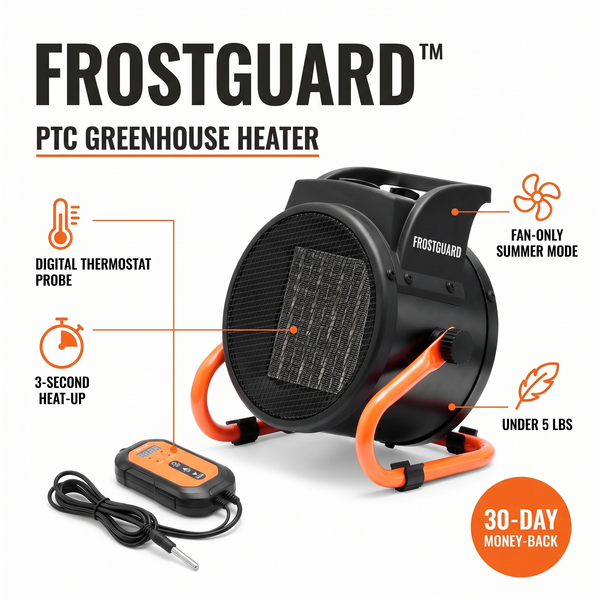
FrostGuard weighs under five pounds and has a carry handle and a tilt stand, so you aim it across the floor instead of at the ceiling. One knob gives you three settings: 800W for most cold nights, 1500W for the hard freezes, and fan-only for summer.

On 800W it costs about 14¢ an hour at the US average electric rate, and only while the thermostat is calling for heat. Most cold nights that's a few hours of run time, not all eight.

iBigger coop, drafty building or a long single-wall run? That's where one unit stops being enough. It's honest cold protection for a small space, and we'd rather you know that before you order than after.
The heater tilted toward a workbench in a home garage, with the chicken coop visible outside in the snow
Reason #5

Coop in January. Garage When You're Working. Greenhouse by March.

A coop heater that only earns its keep on the ten worst nights of the year ends up in the shed. FrostGuard doesn't have to. It's the same heater in the coop, the garage workshop and the seed-starting greenhouse. Pick it up by the handle and move the probe to wherever the cold is.

Clip the probe at the roost in January. Lay it on the workbench when you're in the garage on a Saturday. Push it into a seed tray in March. Every space it lands in holds the number you set, and in July the fan-only setting moves air with no heat at all.

That's why the price makes sense: one heater and one thermostat that work all year, not just for a few weeks of it.

iFall Sale: $149.95, down from $199.95. Digital thermostat and probe included free, free shipping, and the 30-Day Frost Guarantee on the whole order.
Watch It Run
Plug it in. Set the number. Walk back to the house.

Twenty seconds in a working coop: plug it in, set the thermostat, and let it handle the cold while the flock goes about its day.

In the Coop

Watch two things. How little setup there is, and that nobody touches it again once the number is set. Set it, forget it, and let the chickens sleep.

Get FrostGuard — $149.95 →
Reg. $199.95 · Free thermostat + probe · Free shipping · 30-Day Frost Guarantee
So — What Is It?
Meet FrostGuard

A 1500W portable heater that runs off its own digital thermostat and temperature probe. Set the number, clip the probe where the birds sleep, and it switches itself on and off all night. Everything you need for coop season comes in one box. Everything but the 2am checks.

The FrostGuard heater, digital thermostat and probe on a barn workbench
✓1500W heater with 800W and fan-only settingsUnder 5 lbs, carry handle, tilt stand to aim it across the floor
✓FreeDigital thermostat controllerLED display, SET / UP / DOWN, set range 40–108°F
✓FreeTemperature probe with cableReads the coop at roost height, not up by the roof
✓Overheat cutoff, ETL listedCuts the power if it runs too hot
✓FreeShipping on every orderOrders process in about a week; expedited shipping at checkout
✓30-Day Frost GuaranteeRun it for 30 nights. If it doesn't hold your number, full refund.
Your First Night — Plug. Set. Clip. Sleep.
1PlugHeater into the controller, controller into a wall outlet (or a 14-gauge or heavier cord). Knob on 800W for most nights.
2SetPress SET and pick your number. Most keepers land around 40–45°F.
3ClipProbe at roost height, out of the heater's direct airflow. Heater on a flat, hard spot with a foot of clear floor.
4SleepBelow your number, it heats. At your number, it shuts off. In the morning the display shows the coop temperature, not frost.
Before the first freeze
Nothing extra to buy. A few things to have ready.
A flat, hard spot on the coop floor; a concrete paver is perfect. A foot of clear floor around it, with the bedding raked back and the waterer on the other side. A wall outlet nearby, or a heavy 14-gauge or thicker outdoor cord rated for 15A if you need the reach. A hook for the controller on the wall and a clip for the probe at roost height. That's the whole setup. The heater, thermostat and probe all come in one box.
Fall Sale — Don't Pay Full Price
$199.95$149.95SAVE $50

Why order now instead of the night of the freeze warning. Orders take about a week to process before they ship, so the time to set it up is before the forecast turns, not during it. Expedited shipping is available at checkout if a cold snap is already on the way.

Get FrostGuard — $149.95 →
Free thermostat + probe · Free shipping · 30-Day Frost Guarantee
30-Day Frost Guarantee
Run it for 30 nights. Then decide.
Set it up in the coop, pick your number and let it run through real cold. If it isn't holding the temperature you set, or you're unhappy with it for any reason, message us within 30 days of delivery for a return and a full refund. No restocking fee.
What chicken keepers ask before they order
Straight answers, including the ones that don't sell heaters.
The big one
Do chickens even need heat?
Many don't. Healthy, cold-hardy birds in a dry, draft-free, well-ventilated coop handle serious cold. Keepers who add heat usually want a floor under the worst nights: frozen waterers, a long cold snap, or simply sleeping through the night. If you're going to heat, a thermostat-controlled heater on the floor is a steadier way to do it than a lamp that's always on.
Safety
Is it safe to run in a coop?
Treat it like any heater: a flat, hard surface, a foot of clear floor around it, bedding raked back, away from water, plugged into a wall outlet or a heavy-gauge cord. It has an overheat cutoff and is ETL listed, and the thermostat shuts it off whenever your number is met. It's rated IP20, so it isn't sealed against dust. Wipe the grille and check the area each week.
Setup
Where does the probe go, and what number do I set?
Clip the probe at roost height, out of the heater's direct airflow, so it reads what the birds feel. Most keepers set somewhere around 40–45°F, enough to take the edge off the worst nights and keep the water from freezing, rather than trying to make the coop warm.
Sizing
How big a coop will it handle?
It's 1500W / 5,100 BTU, sized for a small backyard coop, shed, garage, or a 6×8 to 8×12 ft greenhouse. Large, drafty or uninsulated buildings want a second unit. It's not a barn heater, and it isn't sold as one.
Cost
What does it cost to run?
On the 800W setting, about 14¢ an hour at the US average rate of 17¢/kWh, and only while the thermostat is calling for heat. Most cold nights that's a few hours of run time, not the whole night.
The fine print
What if it doesn't work for my coop?
Message us within 30 days of delivery and we'll walk you through a return and a full refund, no restocking fee. Shipping is free, orders process in about a week, and expedited shipping is available at checkout.

The short version: if you're going to put heat in the coop, put in heat that knows what temperature it is. Then go back to bed.

The night shift ends here. You keep chickens because you like it, and the 2am flashlight walk was never part of the deal.

FrostGuard is $149.95 in the Fall Sale, down from $199.95, with the digital thermostat and probe included and free shipping. Set your number tonight, clip the probe at the roost, and let it handle the cold. You get 30 nights to make sure it's right for your coop.

Get FrostGuard — Set It Tonight →
Set it, forget it, and let the chickens sleep. You too.